


President Prabowo Subianto delivered an ambitious statement in his address to the United Nations General Assembly, emphasizing Indonesia’s commitment to fulfilling the 2015 Paris Agreement and achieving net-zero emissions no later than 2060. He further stated that, beginning next year, the majority of Indonesia’s additional power generation capacity will rely on renewable energy sources.
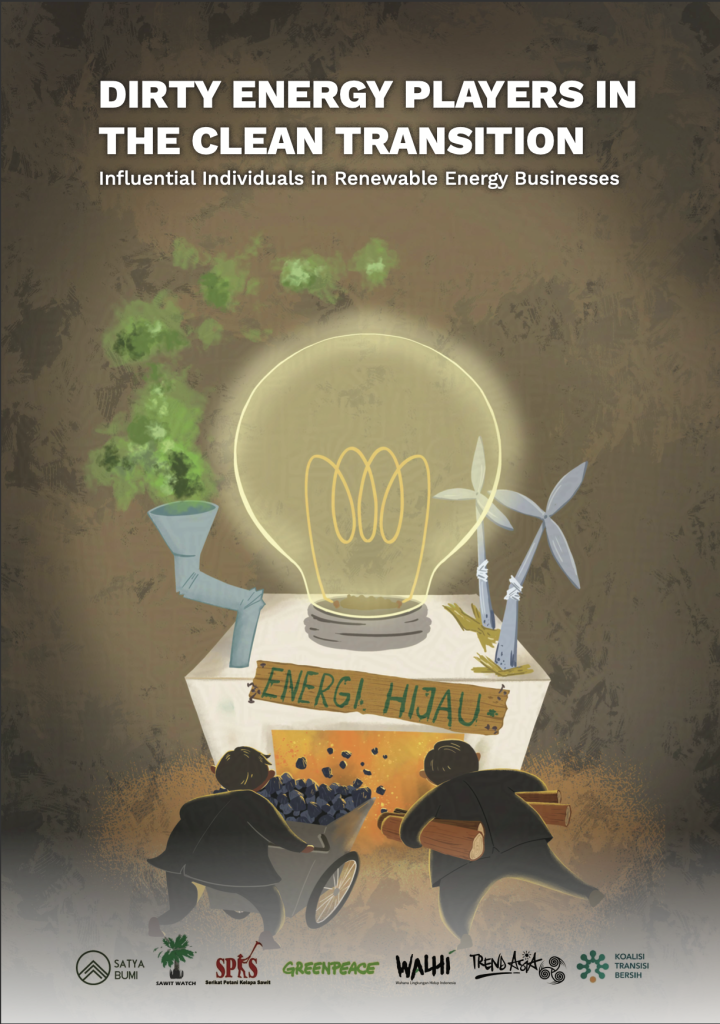
However, ongoing energy transition efforts that continue to focus primarily on energy mix targets remain problematic and fall far short of the ideals of a truly green transition. The Clean Transition Coalition—comprising several civil society organizations, including Satya Bumi, Trend Asia, Sawit Watch, SPKS, Greenpeace, and Walhi—has found that Indonesia’s energy transition approach does not lead to a transformation of the energy governance system, but rather amounts to a mere technological substitution. This non-transformative approach, combined with high project costs and the pursuit of energy mix targets, has resulted in an energy transition that tends to benefit incumbent players who remain actively engaged in dirty energy businesses.
Recurring flawed practices in the energy transition process are also driven by the proliferation of conflict-of-interest spaces and the involvement of networks of Politically Exposed Persons (PEPs). The Clean Transition Coalition identified at least 28 individuals who meet the criteria of PEPs under the United Nations Convention against Corruption (UNCAC) and Indonesian Financial Services Authority Regulation No. 01/2017, operating behind six major energy business groups. Individuals within these PEP networks occupy highly strategic positions in the energy transition process, serving as stakeholders within the executive branch, the judiciary, and law enforcement agencies.
It is acknowledged that not all of these individuals are directly involved in formulating or making decisions that support energy businesses. In fact, most are positioned at the level of parent companies or strategic holding entities that oversee multiple business sectors, rather than being directly embedded in renewable energy operations. Nevertheless, the presence of PEPs across all corporations examined in this study demonstrates the inherent political risks embedded within Indonesia’s renewable energy industry.