

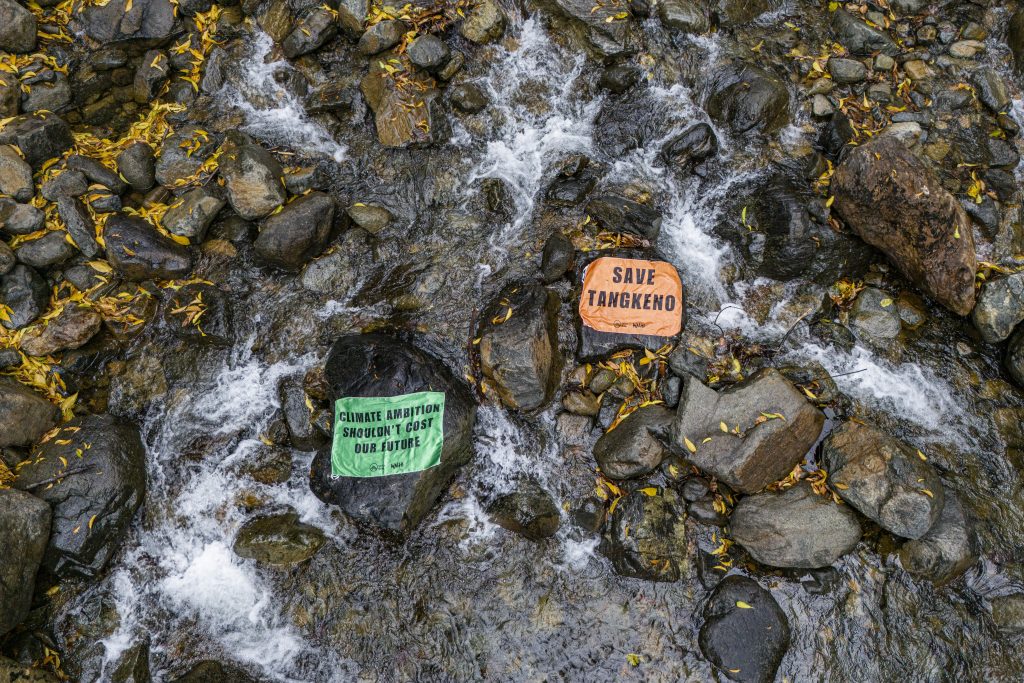
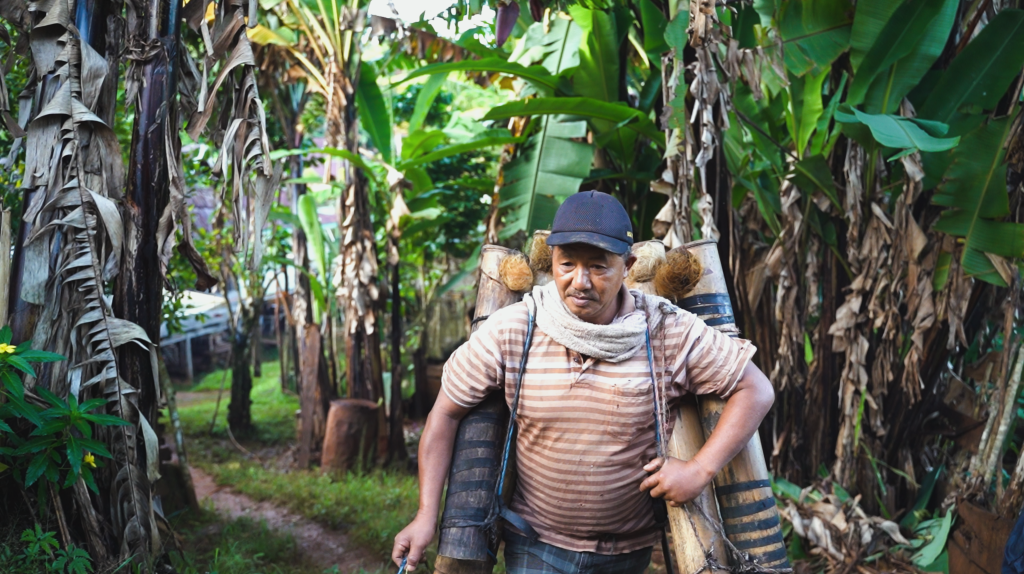
Masdal (54) starts his day as usual. He wakes early, braving the cold mountain air of Tangkeno to tap sugar palm sap. This source of his family’s livelihood has been passed down for generations.
Masdal walks slowly from his house toward the sugar palm trees that grow abundantly on the steep slopes of Tangkeno. With the skill inherited from his father and grandfather, he climbs the tall palm trunks without hesitation, as if his body has long been in rhythm with the forest.
Once the sap is collected, Masdal carries the bamboo containers home and begins cooking it down, stirring until it thickens and turns a deep brown. While stirring the sap, we chat with him about daily life in Tangkeno. Masdal admits he knows nothing about the nickel mining concession in his village.
“I don’t know anything about any mining planned for Tangkeno. Last year a company suddenly came, wanting to take soil samples. There was no permission from the villagers, no information for us… as if this land belongs to no one,” he said plainly.
Masdal has never completely grasped the mounting threat to the very forest he depends on behind that everyday routine.
He does not know that the hill where the sugar palms grow has long been included in a mining concession map. He does not know that the company’s presence last year was a sign that major changes were waiting at the edge of the village.
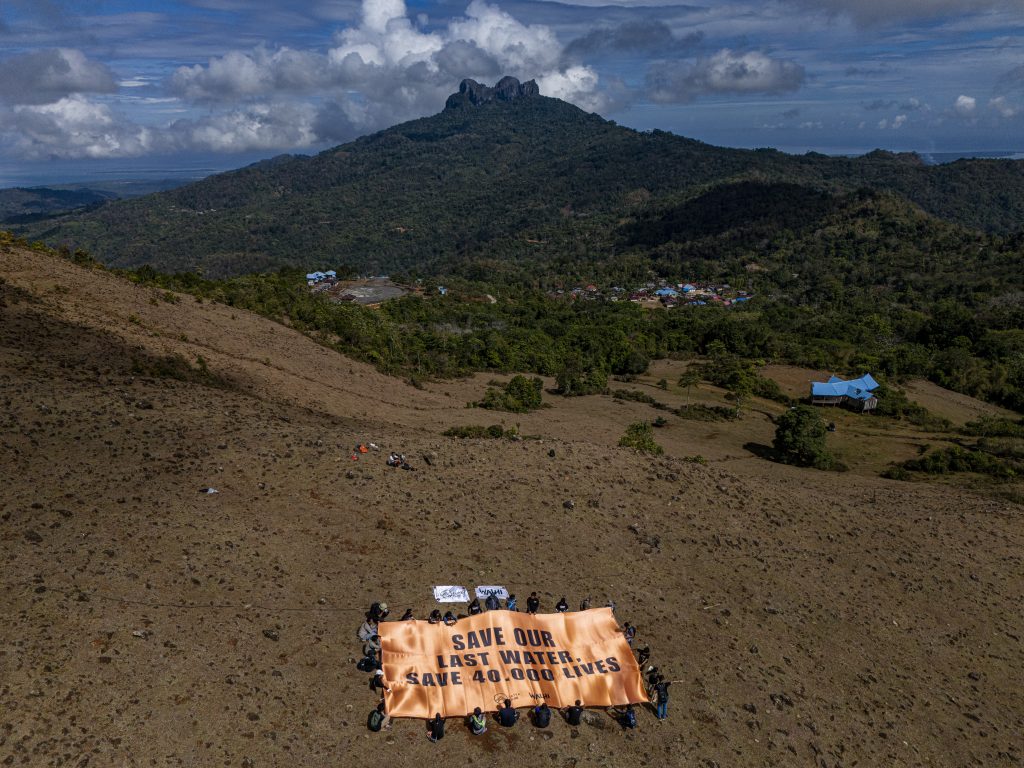
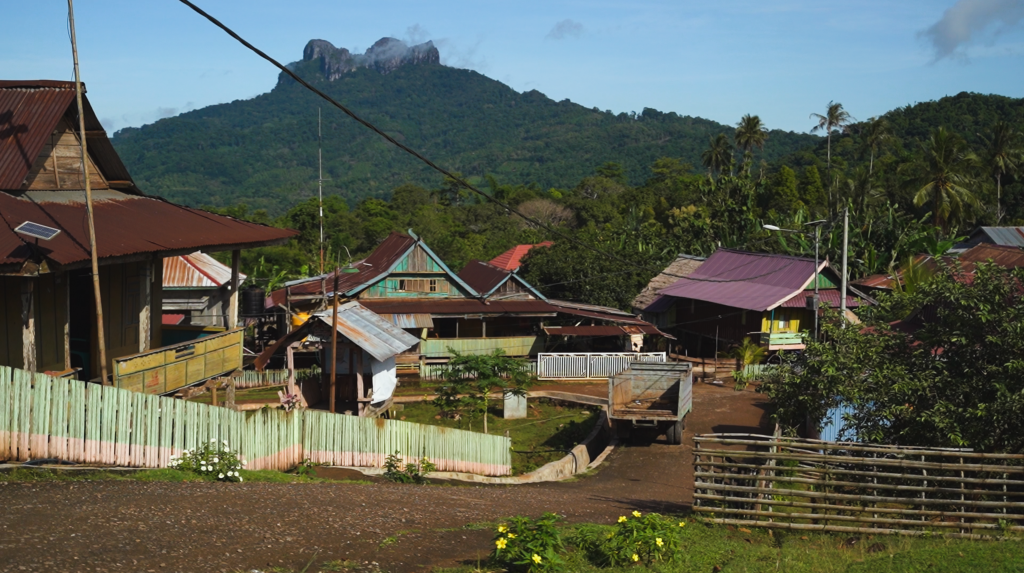
Situated at more than 700 meters above sea level, Tangkeno is the last oasis amid the roar of mining machinery slowly encircling Kabaena Island. The people of Tangkeno are mostly from the Moronene tribe—the Indigenous community of Southeast Sulawesi that has inhabited Kabaena since the era of the Bombana kingdom.
They live in harmony with nature. Each day they farm, harvest sugar palm sap, dry coffee beans, and tend clove trees and cashew orchards—activities that are not merely work, but the heartbeat of a way of life passed down through generations. Among their agricultural products, palm sugar is one of the main economic pillars, contributing around 55% of the village’s income, valued at approximately IDR 871.500.000 (52.067 USD) per year.
Living is not merely earning a livelihood for the Moronene people. Every drop of sap taken, every tree tended, and every harvest dried is an expression of reciprocal care between people and nature.
However, behind Tangkeno’s calm landscape lies a major threat that has quietly crept along the slopes of Mount Sabampolulu. That threat comes in the form of a mining business permit (IUP) held by PT Bakti Bumi Sulawesi (BBS). The company, which has held an establishment permit since 2008, obtained production operation status in 2023—meaning they can begin mining at Kabaena at any time.
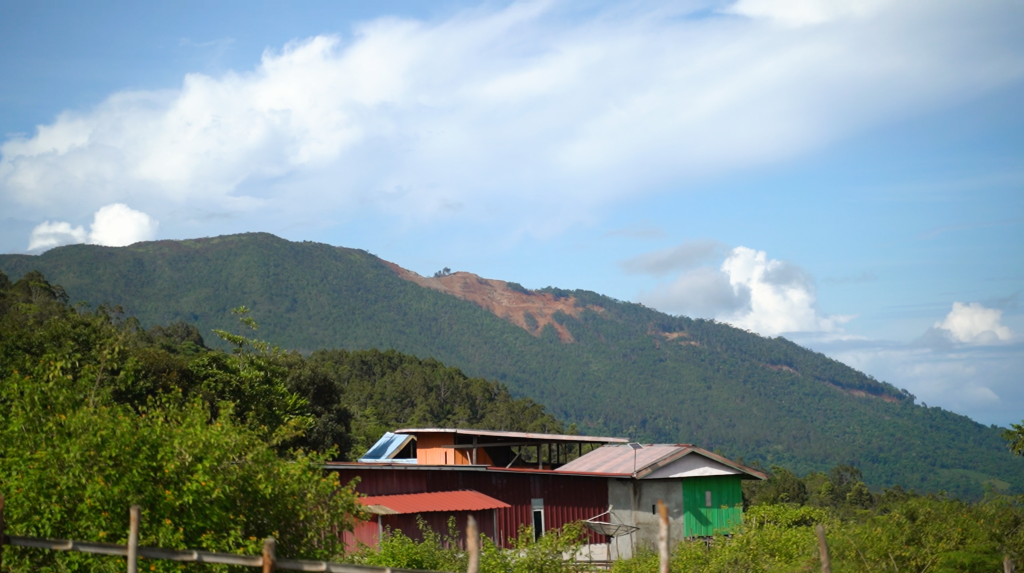
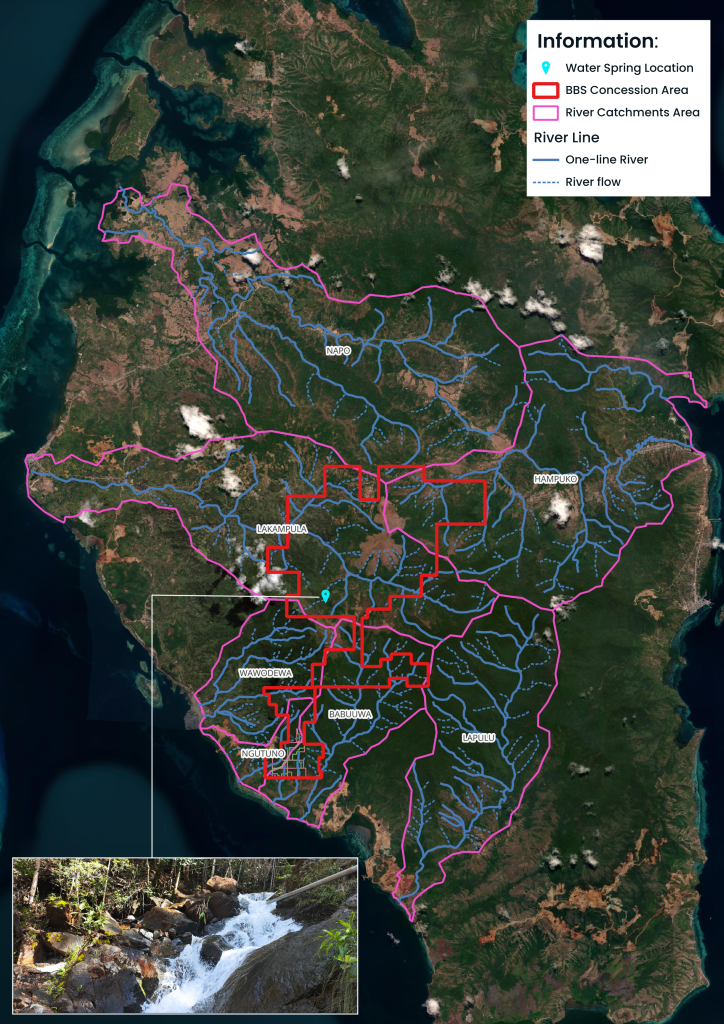
Administratively, PT BBS controls a significant portion of Kabaena’s protected forest. Its concession spans 4.888 hectares, and a large share of that—at least 2.758,17 hectares—lies within protected forest, the natural shield guarding the island from landslides, drought, and ecological collapse. Moreover, the concession encroaches on Tangkeno’s customary territory, affecting around 2.320,54 hectares of land that the community has long managed through ancestral stewardship.

The permit held by the company clearly does not cover empty or uninhabited land. Land-cover data from Indonesia’s Ministry of Environment and Forestry (KLHK) from 2022 shows that around 44,7% of BBS’s concession is still intact forest, consisting of 21,4% primary dryland forest and 23,3% secondary dryland forest.
Since receiving production operation status, the company has begun entering Tangkeno’s territory, creating tension among the residents. In 2024, the company was known to have taken soil samples from the area. More concerning, most villagers were unaware that their lands had already been carved into concession zones on official maps. On paper, the very land where they farm, herd livestock, and collect water—the place their lives depend on—is now part of a mining zone. BBS has already failed to meet the most basic human rights standard: free, prior and informed consent (FPIC).
It is difficult to comprehend what the government was thinking when defining the boundaries of this concession. Within the IUP lies Tangkeno’s main water source—one of the last clean water sources left on Kabaena Island. From this spring flow three major rivers: Lapaku River to the east, passing through Enano, Ulungkura, Wumbuburo, Toli-toli, and Balo; Lamapo River to the north, flowing toward Tedubura, Sangia Makmur, Subar, and Lamonggi; and Lakambula River to the west, flowing to Tirongkotua, Rahadopi, Teomokole, Rahampuu, and Sikeli.
Satellite monitoring makes the scale of risk even clearer. Analysis shows that BBS’s concession overlaps with seven river catchments (DAS) that supply water to numerous villages across Kabaena. These seven catchments form a highly vital hydrological system: they support agriculture, provide drinking water, and maintain ecological stability on a small island that is extremely fragile.
The proportion of each catchment affected illustrates plainly that the threat extends far beyond one village—it endangers the environment and the people across all of Kabaena. If these areas are opened for mining, it is not only farms that will be lost, but entire forms of life that depend on them.
Business Structure of BBS and the People Who Benefit From It
Residents report that BBS plans to begin operations at the end of 2025, starting from its concession area in Pongkalaero before moving into Tangkeno’s customary territory. An investigation into its beneficial ownership and corporate network reveals strong links between BBS and the Huadi Group, the company developing the nickel industrial estate and smelter in Bantaeng.
In BBS’s official structure appear names such as Wang Jueqin (President Commissioner), Jos Tanto (Commissioner), Wang Meiling (Director), and Leonard Haryanto (President Director). Leonard also serves as a Director at PT Huadi Nickel-Alloy Indonesia (HNAI), the largest Rotary Kiln Electric Furnace (RKEF) smelter in the Bantaeng Industrial Estate.
This smelter was previously owned by BBS and has held a PLN electricity supply guarantee of 120 MW since 2012—when the company was under Jos Yanto, a figure who appears in numerous mining and energy companies such as PT Bumi Konawe Mining, PT Wawonii Makmur Jayaraya, PT Sarana Sultra Ventura, and PT Arga Morini Indah.
The business network of PT BBS extends even further. HNAI has ties to foreign entities such as Shengwei New Energy Pte. Ltd, which invests in the Sorong Special Economic Zone. These affiliations show that PT BBS’s operations on Kabaena are part of a much larger national and global nickel industry chain.
Although BBS has no shareholders classified as Politically Exposed Persons (PEPs), some shareholders still have notable profiles. Through PT Duta Nikel Sulawesi appears the name Amir Jao, frequently reported in the media over meetings with military officials, governors, and PLN executives. Another shareholder, Johnlee Mailoa, appears in the Panama Papers through Prime Capital Investment Offshore and Sharecorp Ltd. He also has substantial business ventures, including serving as a Commissioner at Sinarmas Multifinance and as a member of the Audit Committee at PT Asuransi Harta Aman Pratama Tbk.
BBS has not yet begun formal operations, but given its shareholder structure and its proximity to the Huadi Group, it is highly likely that nickel ore from Kabaena will ultimately be sent to HNAI in Bantaeng. BBS’s increasingly aggressive activity raises serious questions—especially as one of its closest affiliates, HNAI, is currently facing issues of halted production and mass layoffs. Although Huadi Group denies this, reports indicate that HNAI had indeed shut down part of its operations. BBS only adds to the list of problems already faced by Bantaeng.
This situation arises alongside a global slowdown in the stainless steel market throughout 2025. Large RKEF smelters such as Gunbuster Nickel Industry (GNI), Indonesia Tsingshan Stainless Steel (ITSS) in Morowali, and Virtue Dragon Nickel Industry (VDNI) in Morosi have shut down production lines. The sluggish market has pressured the class-2 nickel industry and pushed companies to shift toward producing nickel matte and nickel sulfate—the key materials for electric vehicle batteries.
Huadi Group is moving in the same direction. They have updated their industrial strategy by positioning Nickel Pig Iron (NPi) and ferronickel as raw materials for the battery supply chain, and developing new subsidiaries like PT Dowstone Energy Material and PT Hengsheng New Energy Material, which focus on refining nickel into matte and sulfate.
These new companies are linked to China’s battery industry: Dowstone Energy Material is associated with Downstone Technology Co. Ltd, while Hengsheng New Energy Material is connected to Zoomwe Hongkong New Energy Technology Co. Ltd, a subsidiary of CNGR Advanced Materials.
CNGR itself is a global giant in battery materials production and has close partnerships with battery manufacturers such as Samsung SDI, CATL, and LG Energy Solution. From these companies, the supply chain continues to global electric vehicle producers like Tesla, Volkswagen, Volvo, Stellantis, Hyundai, and many others.
These connections show that BBS’s operations are not merely a routine mining preparation—they are part of a much larger industrial strategy that positions Kabaena as a raw material source for the global electric vehicle supply chain. Meanwhile, the local community remains the most vulnerable, bearing the burden of forest loss, vanishing water sources, and the threat to living spaces they have protected for centuries.
Tangkeno has long been the lifeline of Kabaena’s people. Here lie the island’s water and food sources. Massive destruction in Tangkeno would erase the last line of defense protecting Kabaena Island.